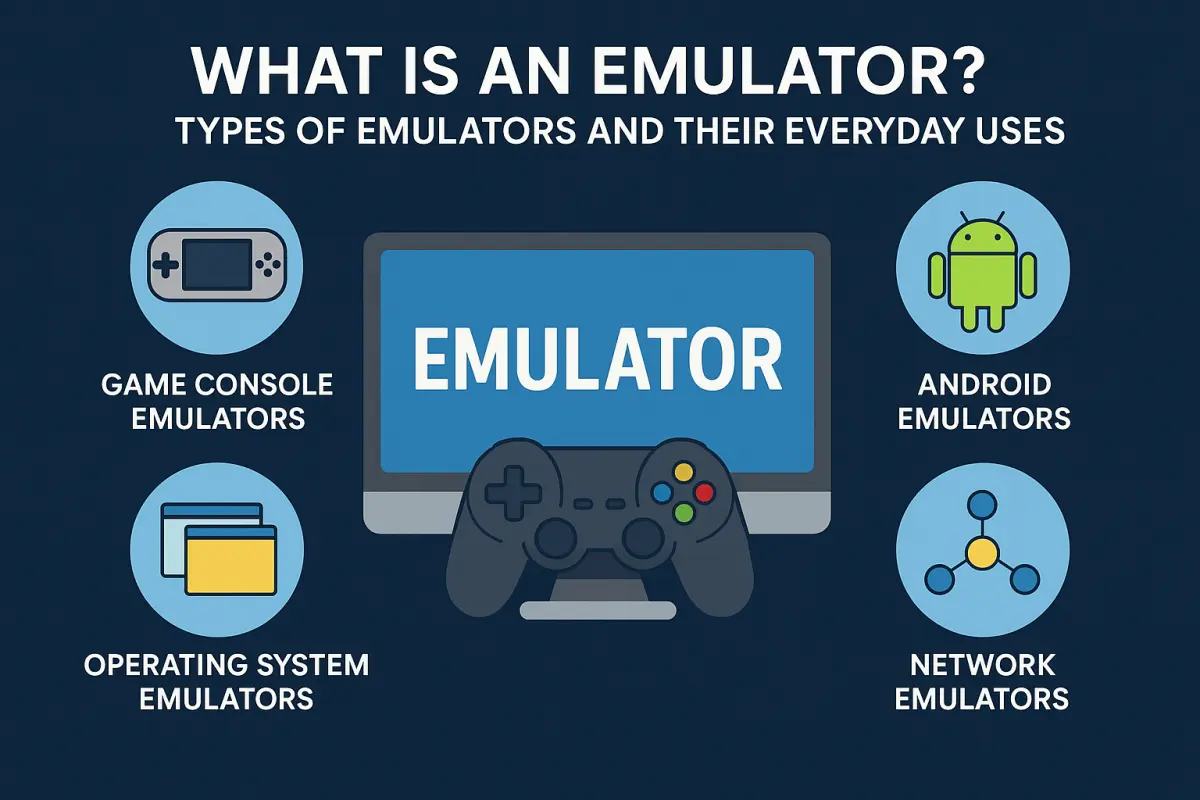
Search "network emulator" and you'll mostly find the same five tools recycled across a dozen near-identical CCNA-prep blog posts: Packet Tracer, GNS3, EVE-NG, Boson NetSim, and Cisco's own VIRL/CML. That list isn't wrong, but it's incomplete in a way that actually matters — it almost always ignores the certification tracks outside Cisco (Huawei's HCIA/HCIP/HCIE, where eNSP is the standard tool) and the academic/research side of network simulation entirely, where a completely different set of tools — NS-3, OMNeT++ — is what actually gets used in coursework and published papers.
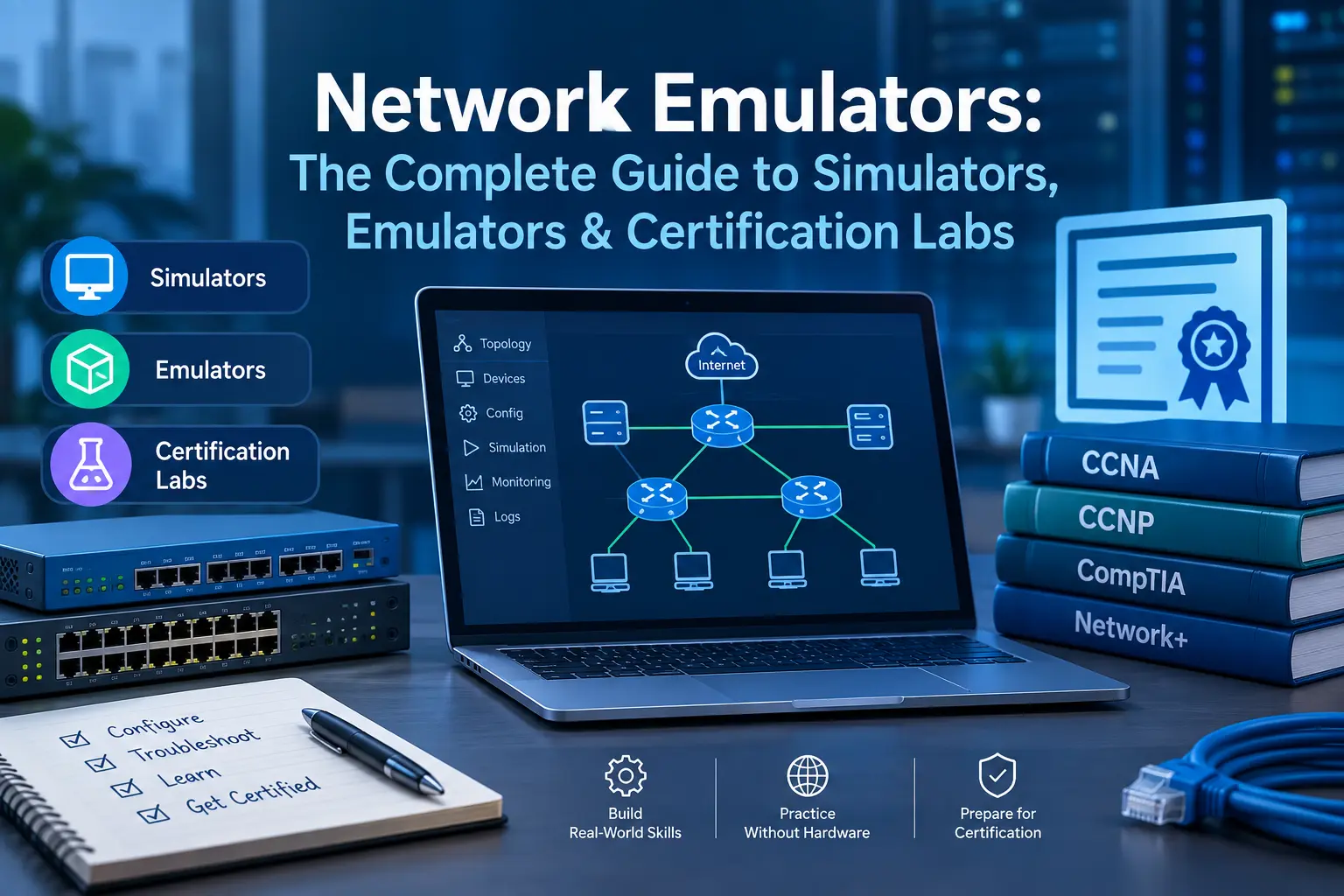
This guide covers all three worlds: certification prep, vendor-specific labs, and research-grade simulation, with six tools total, each linking to a dedicated setup guide rather than a two-sentence summary.
Simulator or Emulator? The Distinction That Actually Matters
These two words get used interchangeably, but the difference decides which tool is right for you.
Simulators model network behavior through simplified logic rather than running real device software. Cisco Packet Tracer and Huawei eNSP fall here — they're built specifically for teaching, so common protocols and topologies work exactly as documented, but edge-case behavior (an obscure OSPF timer interaction, an unusual STP scenario) won't always match a real device, because there's no real device involved.
Emulators run the actual network operating system — real Cisco IOS, real vendor firmware — inside a virtual machine. GNS3 and EVE-NG both work this way. The payoff is fidelity: if it works in GNS3, it'll behave the same way on physical hardware, which is exactly why CCNP and CCIE candidates lean toward emulators once Packet Tracer's simplified model stops being enough. The cost is that you generally need to source the actual OS images yourself — legitimately, through a Cisco support contract, a Cisco Networking Academy student account, or your employer's licensing — since GNS3 and EVE-NG don't ship Cisco's proprietary software themselves.
NS-3 and OMNeT++ sit in a third category: research-grade discrete-event simulators. They're not built around any single vendor's hardware at all — they model network protocols mathematically at a level of detail useful for academic research, thesis work, and testing new protocol designs before anyone builds real hardware for them.
How to Actually Choose One
What are you studying or building toward? A CCNA candidate learning VLANs and static routing for the first time gets more out of Packet Tracer's simplicity than GNS3's realism — the extra fidelity just adds friction at that stage. A CCIE candidate needs the opposite: Packet Tracer's simplified protocol behavior will actively mislead you at that level. HCIA/HCIP/HCIE candidates should go straight to eNSP, Huawei's own tool, rather than trying to adapt Cisco-focused software to Huawei content. Computer science students and researchers modeling protocol behavior want NS-3 or OMNeT++, not a certification simulator at all.
What can your hardware actually run? This is where a lot of people get stuck later than they should. Packet Tracer, eNSP, and Boson NetSim run comfortably on nearly any modern laptop. GNS3 and EVE-NG scale with topology size — a handful of nodes runs fine on 8GB of RAM, but once you're building CCNP-style topologies with 8–10 devices, 16GB becomes the realistic minimum, and full CCIE-scale labs with 20+ nodes running simultaneously want 32GB and a multi-core CPU that won't throttle under sustained load. Check your topology size against your RAM before you sink hours into building a lab that grinds to a halt halfway through.
Do you actually have the OS images you need? If you're planning to emulate real Cisco or Huawei devices in GNS3 or EVE-NG, confirm you have a legitimate way to obtain the images first — through a support contract, student program, or your employer. This trips up more beginners than any actual software bug in either tool.
Quick Comparison
For Cisco certification prep:
- Cisco Packet Tracer: Cisco's own simulator, built for CCNA fundamentals. Simplified device behavior. Free with a Cisco Networking Academy account. Runs on almost any laptop.
- GNS3: Open-source emulator running real Cisco IOS images. Built for CCNP/CCIE-level realism. Free, but you supply your own device images. Needs 16GB+ RAM for serious topologies.
- EVE-NG: Multi-vendor emulator (Cisco, Juniper, MikroTik, and more) running real images. Popular for advanced, multi-vendor labs. Free community edition. Similar hardware demands to GNS3.
For Huawei certification prep:
- eNSP: Huawei's own official simulator for HCIA, HCIP, and HCIE study. Free, Windows-based, and the direct equivalent of Packet Tracer for Huawei's certification track.
For academic and research network simulation:
- NS-3: Open-source discrete-event simulator with GUI and command-line interfaces. Widely used for MANET and wireless mesh network research. Free.
- OMNeT++: Modular C++ simulation framework used across academic protocol research and coursework. Free for academic and non-commercial use.
Best for Cisco Certification Prep
Cisco Packet Tracer is where nearly everyone studying for the CCNA starts, and for good reason — it's Cisco's own tool, built specifically for the Networking Academy curriculum, and its simplified device model means you spend your time learning what a configuration does instead of fighting an unfamiliar interface. Its ceiling is real, though: once you're past CCNA territory, the simplified behavior stops matching how real hardware responds to edge cases, which is exactly when most people move on to an emulator.
GNS3 is that next step for a lot of CCNP and CCIE candidates. Because it runs actual Cisco IOS images rather than simulating them, what works in GNS3 works identically on physical hardware — genuinely useful when you're troubleshooting something subtle enough that "close enough" isn't good enough anymore. The trade-off is setup: you'll need your own IOS images and enough RAM to run them, and the learning curve is steeper than Packet Tracer's.
EVE-NG solves a specific problem GNS3 doesn't handle quite as gracefully: multi-vendor topologies. If your lab needs to mix Cisco gear with Juniper, MikroTik, or other vendors — increasingly common as real networks stop being single-vendor — EVE-NG's setup is generally considered more straightforward for that than piecing it together in GNS3.
We've put Packet Tracer and GNS3 head-to-head in more detail, including which one to pick for your specific certification track, in our full comparison.
Worth knowing about even though we don't host a dedicated page for either: Boson NetSim is a paid tool built specifically around guided Cisco exam practice with bundled study labs, and Cisco's own VIRL/CML is the official, most accurate emulation platform Cisco sells directly — genuinely excellent, but priced and resourced for serious CCIE-track study rather than a first CCNA attempt.
Best for Huawei Certification Prep
If you're on the Huawei track — HCIA, HCIP, or HCIE — none of the Cisco-focused tools above are the right starting point, because they simulate Cisco's command syntax and device behavior, not Huawei's.
eNSP is Huawei's own free simulator, and it plays essentially the same role for Huawei certifications that Packet Tracer plays for Cisco's: an approachable, official tool built around the exact devices and command structure the exam actually tests. It's a genuinely underrated tool in English-language networking content — most "best network simulator" roundups skip it entirely despite real, consistent demand from HCIA and HCIP candidates.
If you're weighing Huawei's certification track against Cisco's, or deciding between eNSP and Packet Tracer specifically, see our detailed comparison of the two.
Best for Academic and Research Network Simulation
Certification candidates and computer science researchers want almost entirely different things from a network simulator, which is exactly why this category gets skipped in most "best network emulator" articles aimed at exam-takers.
NS-3 is the tool most commonly cited in published networking research, particularly for wireless mesh networks and MANETs (mobile ad hoc networks). It gives you both a GUI for building topologies and a command-line/scripting interface for the kind of fine-grained, repeatable experiments research work actually needs.
OMNeT++ takes a modular, component-based approach built in C++, and it's a mainstay in university networking courses and thesis projects specifically because that modularity makes it straightforward to build and test a new protocol idea from scratch rather than just configuring existing device behavior.
Also worth knowing if you're in this space: Mininet is a lightweight tool popular for software-defined networking (SDN) research and experimentation, and CORE (Common Open Research Emulator) is used in some academic and defense-research contexts — both well regarded, though we don't currently host dedicated pages for either.
Getting Set Up Safely
The tools above are all legitimate, widely used software with no legal gray area around the tools themselves — the actual risk is the same one that applies to any free software download: where you get the installer from. Stick to the developer's own site or a page you trust (each tool linked above has its own setup guide with the current installer), and if you're building a Cisco or Huawei emulation lab in GNS3 or EVE-NG, confirm your device images come from a legitimate source before you invest hours building topologies around them.
Frequently Asked Questions
What's the difference between a network simulator and a network emulator? Simulators (Packet Tracer, eNSP, NS-3, OMNeT++) model network behavior through software logic rather than running real device firmware. Emulators (GNS3, EVE-NG) run the actual operating system a real device would run, inside a virtual machine — higher fidelity, but more setup and more hardware demand.
Which network simulator should I use for CCNA? Cisco Packet Tracer, without much debate — it's Cisco's own tool, built specifically for the Networking Academy curriculum the CCNA is based on.
What should I use for CCNP or CCIE labs? GNS3 or EVE-NG. Both run real IOS images, which matters once you're past foundational concepts and need lab behavior that matches production hardware exactly.
Is there an equivalent of Packet Tracer for Huawei certifications? Yes — eNSP is Huawei's own official simulator, built for HCIA, HCIP, and HCIE study specifically.
Do I need powerful hardware to run these? Depends entirely on the tool and topology size. Packet Tracer, eNSP, and Boson NetSim run fine on ordinary laptops. GNS3 and EVE-NG scale with your topology — a small lab is light, but CCNP-scale or larger topologies genuinely need 16GB+ of RAM to stay usable.
Our Picks by Category
- Best for CCNA beginners: Cisco Packet Tracer
- Best for CCNP/CCIE-level realism: GNS3
- Best for multi-vendor labs: EVE-NG
- Best for Huawei certification tracks: eNSP
- Best for academic/research simulation: NS-3 or OMNeT++
Whichever track you're on, every tool above links through to a setup guide with the current installer and the system requirements to check before you start building.

![Best Android Emulator for Low-End PCs [2025]](/storage/blog/images/best-android-emulator-for-low-end-pcs-2025-1_SsFbyyId.webp)